Hopp til innhold

#KlimaOslo

Size: medium

Type: image

referansebane, rapport, bilde av padlere i Bjørvika

Rapport

Referansebane for klimagassutslipp i Oslo fram til 2030

CICERO Senter for klimaforskning og Transportøkonomisk institutt (TØI) har utarbeidet en referansebane for klimagassutslipp i Oslo kommune fram til 2030 og en beregningsmodell for videre analyser av utslipp og mulige klimatiltak, på oppdrag fra Klimaetaten i Oslo kommune.

Referansebanen gir anslag for hvordan klimagassutslippene innenfor Oslos grenser kan utvikle seg hvis det ikke gjennomføres ytterligere klimatiltak etter utgangen av 2021.

Resultatene viser at utslippene kan ventes å gå ned fra 2020 til 2030, og betydelig ned i forhold til anslått 2009-nivå, men at allerede gjennomførte tiltak bare oppnår knapt halvdelen av Oslo kommunes klimamål om 95 prosent reduksjon fra 2009 til 2030.

Les mer

  • Referansebane Oslo 2022 CICERO Report 2022-03

Size: medium

Type: image

Sektordiagram som viser distribusjon av klimagasser i 2020: Karbondioksid 93 %, Metan 5 %, Lystgass 2 %.

Rapport

Klimagassregnskap for Oslo, 2009–2020

Miljødirektoratets kommunefordelte klimagassregnskap ligger til grunn for utarbeidelsen av klimabudsjettet. 18. januar 2022 publiserte Miljødirektoratet oppdatert klimagassregnskap for kommuner, med en korrigering for sektoren energiforsyning sendt per e-post til Klimaetaten 14. mars 2022.

Klimagassregnskapet har nye tall for 2020, og oppdaterte tall for tidsserien tilbake til 2009. Dette notatet oppsummerer og kommenterer utviklingen for klimagassutslippene i Oslo fra 2009 til 2020, og forklarer hvilke metodiske endringer som er gjort siden forrige klimagassregnskap ble publisert i 2021.

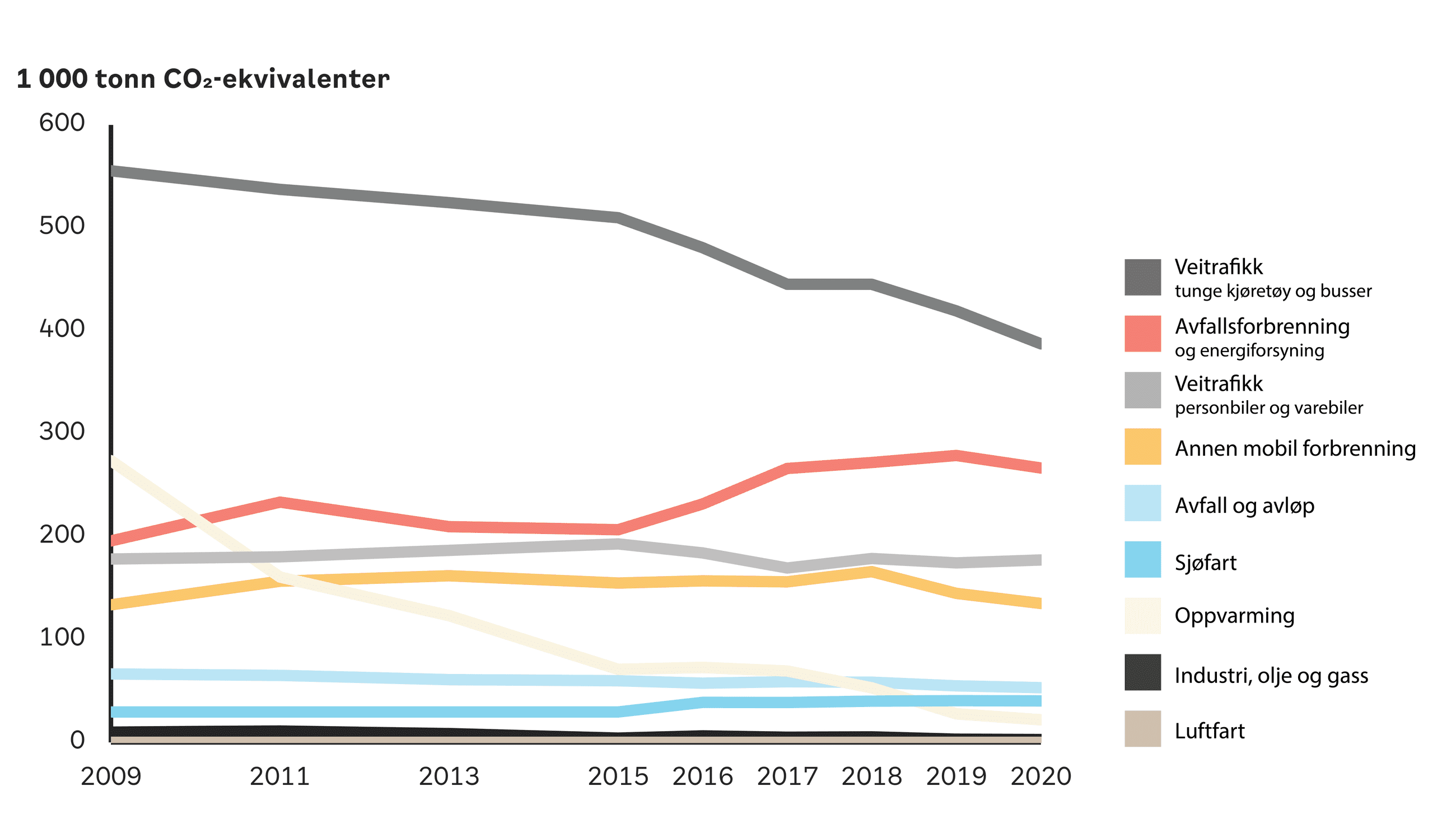
Klimagassregnskapet viser at klimagassutslippene i Oslo i 2020 var på om lag 1,08 millioner tonn CO2-ekvivalenter. Dette er en nedgang på 5,2 prosent fra 2019. Klimagassutslippene har i perioden 2009-2020 aldri vært så lave som i 2020, og sammenliknet med 2009-nivå har utslippene gått ned med 25 prosent.

  • Utslipp fra alle sektorer er redusert mellom 2019 og 2020. For sektorene avfall og avløp, industri, olje og gass, luftfart, oppvarming og veitrafikk var utslippene i 2020 på det laveste nivå for tidsperioden 2009 til 2020.
  • Utslippene fra veitrafikk gikk ned med 4,9 prosent, tilsvarende i underkant av 30 000 tonn CO2-ekvivalenter, som følge av økt andel elbiler og innblanding av biodrivstoff.
  • Utslippene fra annen mobil forbrenning gikk ned med 6,8 prosent og i underkant av 10 000 tonn CO2-ekvivalenter. Beregningsmetoden for utslipp fra annen mobil forbrenning er imidlertid usikker, noe som gjør det utfordrende å forklare både utslippsnivå og –trend i sektoren.
  • Utslippene fra oppvarming gikk ned med 21,1 prosent, tilsvarende i underkant av 6 000 tonn CO2-ekvivalenter, og er knyttet til en kraftig nedgang i bruk av fossile oppvarmingskilder. Nedgangen er et resultat av oljefyringsforbudet gjeldende fra 1. januar 2020.
  • Utslipp fra avfallsforbrenning og energiforsyning ble redusert med 4,4 prosent, tilsvarende om lag 12 000 tonn CO2-ekvivalenter og skyldes i hovedsak mindre bruk av fossile energikilder i fjernvarmeproduksjon.

klimagassregnskap, utvikling per sektor siden 2009, figur

Klimagassutslipp fordelt per utslippssektor, 2009-2020. Klimagassregnskapet mangler data for årene 2010, 2012 og 2014. Utslippsnivået er derfor interpolert for disse årene.

Klimagassregnskapet er under kontinuerlig forbedring. Det er gjort metodeendringer i årets publiserte tall, men det er fortsatt behov for videreutvikling. Miljødirektoratet vil fortsette arbeidet i 2022. Det kan derfor forventes justeringer i tallene som forventes publisert i desember 2022. Justeringer som følger av metodeendring vil påvirke utslippene i hele tidsserien, fra 2009 til siste år med statistikk.

Utredning med tiltak for utslippsfri og ressurseffektiv avfallshåndtering i Oslo

Sammendrag

Avfallshåndtering med økt ressursutnyttelse utgjør en viktig del av sirkulærøkonomien. Framover vil harmonisering av norsk regelverk til EU-regelverket føre til flere og hyppigere endringer. Økte krav til sortering og materialgjenvinning av avfall vil være en del av dette.

Gjennom forslag til konkrete tiltak knyttet til husholdningsavfall og næringsavfall, inkludert kommunalt virksomhetsavfall, viser denne utredningen hvordan Oslo kan øke materialgjenvinningsgraden opp mot 65 prosent, og samtidig ivareta målet om at avfallshåndteringen skal være tilnærmet uten direkte utslipp av klimagasser i 2030.

Denne utredningen utgjør også en del av faggrunnlaget for temaplan for sirkulær økonomi.

Oslo har et kretsløpsbasert avfallssystem basert på ombruk, kildesortering, materialgjenvinning og energigjenvinning. Av dagens rapporterte klimagassutslipp i Oslo kommer 22 prosent fra avfallsforbrenning. Oslo Fortum Varmes anlegg står for 83 prosent av dette, mens de resterende 17 prosentene kommer fra kommunens anlegg på Haraldrud (husholdningsavfall). I dag dekkes om lag 20 prosent av oppvarmingsbehovet i Oslo av fjernvarme fra avfallsforbrenningen.

Utsortering og materialgjennvinning

Det er anslått at det produseres i underkant av 800 000 tonn avfall i Oslo årlig. Kommunen har ansvar for husholdningsavfall og eget virksomhetsavfall. Næringslivet har ansvar for eget avfall. Avfallsmengdene fra Oslos husholdninger var i overkant av 215 000 tonn i 2019, hvorav 39 prosent ble sendt til materialgjenvinning. Tallene for næringsavfall er mer usikre, men kartlegging tilsier at bygg- og anleggsavfall utgjør ca. 340 000 tonn, mens ca. 230 000 tonn avfall kommer fra tjenesteytende næring (som inkluderer avfall fra kommunal og annen offentlig virksomhet) [1] [2]. Ca. 31 prosent av den totale avfallsmengden fra næring ble materialgjenvunnet og ca. 3 prosent gikk til biogassproduksjon. Om lag 5 prosent av næringsavfall kommer fra kommunale virksomheter.

Teoretiske beregninger for husholdningsavfallet viser at vi med dagens kunnskap, tiltak og virkemidler kan nå en utsorteringsgrad opp mot 65 prosent innen 2030, mens materialgjenvinningsgraden vil være i underkant av 60 prosent. Direkte klimagassutslipp fra forbrenning av husholdningsavfall på Haraldrud energigjenvinningsanlegg (HEA) vil samtidig kunne reduseres med ca. 70 prosent. Utsortering av plastavfall til materialgjenvinning er hovedkilde til denne reduksjonen. Etablering av karbonfangst (CCS) vil fange både fossilt og ikke-fossilt (biogent) CO2. Karbonfangsten fra næringsavfall kan dermed bli større enn den totale mengden fossilt CO2 som slippes ut, og gi «negative» utslipp. Negative utslipp er ikke inkludert i klimagassregnskapet i dag.

For husholdningsavfall ligger det største potensialet for måloppnåelse om 65 prosent materialgjenvinning, i å øke utsorteringen av matavfall, plastavfall og trevirke.

Potensialet for reduserte klimagassutslipp ligger i hovedsak i avfallstypene plastavfall og glass- og metallavfall. De kommende utsorteringskravene for plast fra nasjonale myndigheter vil nås med foreslåtte tiltak. Det er større usikkerhet om det kommende utsorteringskravet nås for matavfall.

For næringsavfall er det størst potensial for økt materialgjenvinning av bygg- og anleggsavfall, samt for utsortering av mat- og plastavfall. For næringsavfall fra kommunens egne virksomheter, er det et potensial for økt utsortering og materialgjenvinning. Krav om utsortering av plast- og matavfall vil også bli gjeldende for næringsavfall.

Oppfølgingen av tiltakene vil variere i forhold til om det er husholdningsavfall, kommunalt virksomhetsavfall, næringsavfall fra tjenesteytende næringer eller bygg- og anleggsavfall, da kommunen har ulik rolle og myndighet.

Utredningen er delt inn i fire deler med fire respektive vedlegg. Kapittel 1 er en felles innledning med rammer og kontekst, kapittel 2 omhandler husholdningsavfall og kapittel 3 omhandler næringsavfall. Her er tall på materialgjenvinningsgrad, klimagassutslipp, framskrivning av avfallsmengder og en redegjørelse for potensialet kartlagt for begge avfallsområder.

I kapittel 4 og nedenfor gis en oppsummering av anbefalte tiltak og relaterte barrierer, forutsetninger, muligheter og risiko, samt kostnader for de viktigste tiltakene. Tiltakene er under gruppert i fire områder i ikke- prioriterte rekkefølge.

Pådriver for forebygging og rammebetingelser

Foreslåtte tiltak (ses i sammenheng med faggrunnlag sirkulærøkonomi):

  • Aktiv påvirkning i utformingen av nasjonale og internasjonale rammebetingelser
  • Ta initiativ til å utrede handlingsrommet i selvkostregelverket for økt effektivitet i avfallshåndteringen
  • Ta initiativ og aktivt arbeide for større krav til produsentansvarsordning, herunder kostnadsfordeling og krav til nye produkter og produktenes iboende egenskaper (økodesign)
  • Legge til rette for redusert forbruk (det vises til blant annet forbruksstrategien, faggrunnlag sirkulær økonomi, med mer [3] [4] [5])
  • Økt satsning på ombruk ved å tilrettelegge for gode ombruksløsninger
  • Ombygging og restaurering av eksisterende bygningsmasse i stedet for rivning
  • Målrettet bruk av innkjøpsmakten ved innovative anskaffelser og å sette krav til varer og tjenester, og arbeide for redusert forbruk og materialgjenvinning av spesielt fossilt avfall
  • Økt informasjon og tilrettelegging for gode brukerløsninger

Utvidet kildesortering/utsortering

Foreslåtte tiltak:

  • Økt innbygger-/brukerdialog, bedre tilrettelagt design og merking
  • Utvidet gebyrdifferensiering for å stimulere til ønsket
  • Tilrettelegge for utvidet kildesortering for å ivareta nasjonale krav og avfallskvalitet i første rekke med vekt på mat- og plastavfall
  • Økt utsortering av fossile avfallstyper (plast- og tekstilavfall) fra restavfall
  • Effektivisere innsamlingen og dialog med innbyggerne/brukerne ved å ta i bruk digitale verktøy og ny teknologi.
  • Følge opp krav til kildesortering for kommunalt virksomhetsavfall
  • Etablere avfallsfaglig rådgiver for kommunale virksomheter
  • Aktiv bruk av insentiver og rådgivning for gode avfallsløsninger hos abonnent (husholdningene)

Teknisk infrastruktur, samarbeid og innovasjon

Foreslåtte tiltak:

  • Bruke kommunens planer og retningslinjer (iht. pbl, Gatenormalen, m.fl.) i nye områder og ved ombygginger, for å tilrettelegge og sikre gode bosteds-/ virksomhetsnære avfallsløsninger og nødvendig infrastruktur for eksisterende og framtidig behov
  • Aktivt bidra til etablering av nye forretningsmodeller for avfallstyper som i dag går til forbrenning og deponi, gjennom samarbeid, stille arealer til disposisjon og bruke tilskuddsordninger
  • Initiere utvikling av ny teknologi og etablering av nye verdikjeder for restprodukter fra avfallsforbrenning, gjennom samarbeid, stille anlegg til disposisjon og bruke tilskuddsordninger
  • Aktiv bruk av innovative anskaffelser for å utvikle verdikjeder for økt materialgjenvinning
  • Videreføre og utvikle forpliktende samarbeid på tvers av kommuner og bransjer for å sikre riktig kapasitet på anlegg
  • Bygge omlastestasjoner for å effektivisere avfallslogistikken

Reduserte klimagassutslipp og etablering av ettersorteringsanlegg

Foreslåtte tiltak:

  • Utrede etablering av ettersorteringsanlegg for utsortering av plast og for å få mest mulig ut av potensialet i restavfallet
  • Øke kunnskap om fossile fraksjoner i avfallet og tilrettelegging for reduserte direkte klimautslipp fra forbrenningsanleggene

Det er identifisert flere forutsetninger, barrierer, muligheter og risikoer knyttet til tiltakene som er foreslått. Disse er beskrevet i kapittel 2.4 (husholdning) og kapittel 3.4 (næring). Risiko og barrierer, men også muligheter, for gjennomføring av tiltakene er ikke-vedtatt regelverk, praktisering av regelverk, arealer og kostnader, samt tilstrekkelig nødvendig data og statistikk. Utsorteringsgraden vil påvirkes av innbyggernes/brukernes oppslutning og brukertilpassede løsninger. For materialgjenvinningsgraden vil utvikling av umodne verdikjeder for enkelte av avfallstypene, og dårlig tilpasset lovverk til sirkulærøkonomi, være viktig for måloppnåelse. Bruk av innkjøpsmakt og innovative anskaffelser er et viktig virkemiddel for måloppnåelsen. Dette vil kunne gi økte kostnader på kort og mellomlang sikt på grunn av umodent marked, men kan samtidig legge grunnlag for samfunnsøkonomiske gevinster i et langsiktig perspektiv.

De største kostnadene og barrierene for husholdningsavfall, er knyttet til både nye løsninger for utsortering av avfallstyper og til etablering av anlegg. Økte kostnader er knyttet til endret logistikk, flere oppsamlingsenheter, innkjøp av flere renovasjonsbiler, kommunikasjon og merking, samt etablering av ny omlastestasjon og nytt ettersorteringsanlegg for restavfall. Tiltakene vil være budsjettbelastende og vil gi økte gebyrer.

For næringsavfall, herunder kommunalt virksomhetsavfall, er kostnadene knyttet til utsortering av flere avfallstyper og økt materialgjenvinning av kildesorterte avfallstyper.

Samarbeidsprosjekter, regionalt samarbeid og klyngeutvikling innen avfallsfeltet pågår. Et mulighetsstudium for økt regionalt samarbeid om husholdningsavfall er under arbeid. Det pågår også utviklingsarbeid i kommunal regi og i samarbeid med forskningsinstitusjoner.

Size: medium

Type: image

avfallshåndtering, renovasjonsbil

Rapport

Utredning med tiltak for utslippsfri og ressurseffektiv avfallshåndtering i Oslo

Renovasjons- og gjenvinningsetaten har i samarbeid med Klimaetaten fått i oppdrag å utrede hvordan Oslo kan øke materialgjenvinningsgraden til minimum 65 prosent, og samtidig ivareta målet om at avfallshåndteringen skal være tilnærmet uten direkte utslipp av klimagasser innen 2030. Utredningen skal resultere i forslag til konkrete tiltak og virkemidler knyttet til husholdningsavfall, kommunalt avfall og privat næringsavfall, som kommunen kan iverksette for å nå målene i 2030. Utredningen skal også utgjøre en del av faggrunnlaget i arbeidet med en strategi for sirkulær økonomi.

Arbeidet med utredningen om fremtidig organisering av Romerike biogassanlegg og vurdering av muligheter for forbrenning av Oslos husholdningsavfall med karbonfangst på Haraldrud er ikke en del av denne utredningen. Hvordan fremtidige anlegg skal driftes er heller ikke en del av utredningen.

Bymiljøetaten, Utviklings- og kompetanseetaten, Plan- og Bygningsetaten, Oslo Havn KF og OsloBygg KF, har også bidratt på flere områder. Selskapene Fortum Oslo Varme (FOV), Norsk Gjenvinning (NG) og Ragn-Sells, har bidratt med innspill og deltatt i møter. Arbeidet har i tillegg blitt presentert i Oslo kommunes nettverk, «Næring for Klima», der medlemmene ble invitert til dialog og innspill.

Les også:

Les mer

  • Utredning med tiltak for utslippsfri og ressurseffektiv avfallshåndtering i Oslo

Faggrunnlag til temaplan for sirkulær økonomi

Sammendrag

Oppdraget om å lage et faggrunnlag utformet som en temaplan skal danne grunnlaget for byrådets strategi for sirkulær økonomi. Temaet sirkulær økonomi er i utvikling, og det er behov for en bredere drøfting og presentasjon av retningen og hvordan Oslo kommune skal jobbe videre med dette. Faggrunnlag for «Temaplan for sirkulær økonomi i Oslo» skal vise hvordan kommunens arbeid for en mer sirkulær økonomi skal bidra til å skape arbeidsplasser, økt verdiskaping og betydelig klima- og miljøgevinst.

Faggrunnlaget skal også synliggjøre gjennomføringen gjennom kommunens eget virkemiddelapparat, samt gjennom å påvirke innretning og bruk av regionale og nasjonale virkemidler.

Oslo har gjennom flere år arbeidet med sirkulære ideer, mål og prinsipper i utformingen av tjenester og politikk. Gjennom arbeid på ulike tjenesteområder er det identifisert barrierer og muligheter for å arbeide mot en sirkulær økonomi både på kommunalt, nasjonalt og internasjonalt nivå. Det er også sett på viktige samarbeidsfora i regionen som kan styrke arbeidet og bidra til å videreutvikle satsningen på sirkulær økonomi i Osloregionen.

«Nasjonal strategi for ein grøn, sirkulær økonomi», lagt frem juni 2021, samt

«Hurdalsplattformen 2021 -2025», en regjeringsplattform for en regjering utgått fra Arbeiderpartiet og Senterpartiet oktober 2021, understøtter kommunens arbeid.

Det foreslås derfor at de fire satsingsområdene innen sirkulær økonomi som kommunen allerede jobber med videreføres og styrkes;

  • Forbruk og varehandel
  • Avfall og energi
  • Bygg, anlegg og infrastruktur
  • lnnovasjonsdistrikter og samarbeid

Forbruk og varehandel

 Gjennom oppfølging av forbruksstrategien og klimastrategien arbeider Oslo kommune for et redusert og mer miljø- og klimavennlig forbruk hos innbyggere og næringsliv. Det foregår en rekke ulike aktiviteter med søkelys på sirkulært forbruk og varehandel i Oslo, bl.a. innenfor ombruk og reparasjon.

Økt kunnskap og holdningsendringer er forutsetninger for et sirkulært samfunn. Det gjøres allerede store regelverksendringer nasjonalt og i EU, der det bl.a. vil stilles strengere krav til produkter og klassifisering av bærekraft i økonomiske aktiviteter (taksonomi-regelverket). Kommunen har en viktig rolle i å påvirke regelverksutviklingen i sirkulær retning.

Oslo kommune er landets nest største innkjøper, noe som gir en betydelig innkjøpsmakt. Offentlige anskaffelser er et viktig virkemiddel for å påvirke forbruk og varehandel i en sirkulær retning. Sirkulære krav i anskaffelser gir ofte økte kostnader, særlig i tidlig fase der markedet ikke er modent. Det er viktig å sikre aksept for økte kostnader og tilgjengelige midler til å stille miljøkrav.

Økt etterspørsel etter og tilrettelegging for sirkulære tjenester som reparasjon og oppgradering, vil gi muligheter for nye forretningsmodeller og arbeidsplasser. Verktøy for miljødokumentasjon og livsløpsanalyser, er viktig som grunnlag for dette.

Eksempler på forretningsmodeller kan være utleietjenester for produkter det i dag er vanlig å eie, eller nye digitale verktøy, samt reparasjonstjenester. Nye forretningsmodeller kan oppstå ved å tilrettelegge for dialog og samarbeid på tvers av verdikjeder.

Det anbefales bl.a. at kommunen oppretter møteplasser på tvers av bransjer og verdikjeder, søker å løse behov på andre måter enn ved nyanskaffelser der dette er mulig, samt utvikler og benytter krav til sirkulære løsninger i anskaffelser.

Avfall og energi

Kommunen har mål om å øke materialgjenvinningsgraden i renovasjonssystemet til 65 prosent og gjøre Oslos avfallshåndtering utslippsfri innen 2030. For å beholde verdiene i materialer, produkter og ressurser i omløp i økonomien lengst mulig, må kommunen legge til rette for at mest mulig av avfallet utsorteres i rene fraksjoner som kan materialgjenvinnes til nye, konkurransedyktige råvarer. Oslo har tilgjengelig infrastruktur for å utnytte både avfall og energi. Denne infrastrukturen må videreutvikles for å sikre at ressursene i større grad enn i dag forblir eller føres tilbake til kretsløpet.

En gjennomgang av utvalgte materialstrømmer viser at det genereres store avfallsmengder av ulike typer i Oslo. Kommunen kan benytte seg av anskaffelser for å bidra til å redusere mengdene av de ulike avfallstypene – ved å stille krav til reparasjon, ombruk og innhold av materialgjenvunnet råvare. Et annet viktig virkemiddel er å påvirke rammevilkårene for avfall, f.eks. produsentansvar og produktregelverk. Det oppstår store avfallsmengder fra næringsvirksomhet i Oslo, men tilgjengelig informasjon om næringsavfall, er begrenset. Kommunen kan stimulere til etablering av sirkulære løsninger for næringsavfall ved å stille krav om sirkulære tjenester for eget avfall.

Økt utnyttelse av overskuddsvarme fra byens aktiviteter i fjernvarmenettet vil kunne frigjøre elektrisitet til andre formål enn oppvarming. I en sirkulær økonomi vil effektiv energibruk være avgjørende, og kommunen bør ta en rolle i planleggingen.

Det er potensial for nye arbeidsplasser ved utvikling av avfalls- og energisektoren. Eksempler er nye løsninger for behandling av avfall. Oslo kommune kan være pådriver for sirkulære avfallstjenester i regionen, ved utvikling av egne anlegg for utnyttelse av bl.a. organiske restprodukter. I tillegg kan kommunen være pådriver for teknologiutvikling og etablering av anlegg, f.eks. anlegg for finsortering og gjenvinning av plastavfall og elbilbatterier.

Det anbefales at kommunen er pådriver for sirkulære behandlingsmåter og forbedret statistikk, i tillegg til å være aktiv innenfor FoU og teknologiutvikling. I tillegg gis det spesifikke anbefalinger for en rekke utvalgte produktgrupper. På energi anbefales det at kommunen jobber for utnyttelse av restvarme fra ulike aktiviteter og tar en aktiv del i energiplanlegging.

Bygg, anlegg og infrastruktur

Oslo har store transformasjonsområder og betydelig byggeaktivitet. De største avfallsmengdene i Oslo oppstår i bygge- og anleggsbransjen. Rivning og nybygg gir store klimautslipp. Det foregår en rekke sirkulære initiativer innenfor bygg og anlegg i byen i dag, bl.a. innenfor ombruk av bygningsmaterialer og massehåndtering.

For å påvirke i en sirkulær retning, kan kommunen rehabilitere eksisterende bygg heller enn å rive og bygge nytt der dette er hensiktsmessig, i tillegg til å vurdere ombruk av bygningsdeler. Kommunen bør også kartlegge arealbehovet for anlegg og aktiviteter som trengs i en sirkulær økonomi, og muligheter for lokal mellomlagring for å øke gjenbruk av masser. Ved å åpne for midlertidig bruk av lokaler og arealer i transformasjonsperioder, kan kommunen legge til rette for start-ups med sirkulære forretningsideer eller mellomlagring av plasskrevende ombruksmaterialer som bygningsdeler og masser. Kommunen kan også vurdere om sambruk av arealer kan begrense det totale arealbehovet.

Det er potensial for nye forretningsmodeller og ev. arbeidsplasser innenfor tjenester for å tilgjengeliggjøre ledige arealer. Å legge til rette for bruk av rimelige arealer som f.eks. kantiner større deler av døgnet, kan også stimulere til nye bedrifter innenfor f.eks. catering eller kafe. Fokus på ombruk av byggematerialer kan medføre at det oppstår forretningsmodeller innenfor distribusjon, salg og dokumentasjon på brukte bygningsdeler.

lnnovasjonsdistrikter og samarbeid

Campus Oslo – strategi for utvikling av kunnskapshovedstaden, ble vedtatt i 2019 og gir retning for utviklingen av innovasjonsdistriktene i Oslo. Visjonen for Hovinbyen Sirkulære Oslo, er at dette skal bli et verdensledende innovasjonsdistrikt for sirkulærøkonomi innen bygg, anlegg og produksjonsnæring.

For å realisere utvikling i en sirkulær retning, bør kommunen legge til rette for samarbeid med akademia, nabokommuner og privat næringsliv og vurdere økonomiske støtteordninger for bedrifter i oppstartsfasen. Kommunen bør videreføre satsingen på Hovinbyen Sirkulær Oslo som Oslos senter for sirkulær økonomi, der kretsløpsparken på Haraldrud er et naturlig kjernepunkt for utvikling av teknologi og sekundære råvarer. Kuben yrkesskole vil være sentrum for utvikling av sirkulær fagopplæring. Kommunen samarbeider allerede med andre kommuner og relevante aktører i regionen, og bør fortsette arbeidet for å identifisere felles løsninger og utfordringer.

Kommunen kan ta en aktiv rolle i å skape nøytrale møteplasser der aktører fra bl.a. næringsliv og akademia, kan møtes på tvers av verdikjeder og bransjer. Næring for klima er eksempel på en slik møteplass. Det er gjennomført workshops med aktører innenfor de utvalgte bransjene mobilitet, forretningsbygg og varehandel. I workshops var tilbakemeldingen fra deltakerne at kommunens viktigste rolle er å tilrettelegge for møteplasser, der aktører på ulike steder i verdikjeder kommer sammen og deler ideer og utfordringer. Slike arenaer for kunnskapsutveksling er etablert bl.a. i København og Flandern.

Kommunen bør øke satsingen på klyngesamarbeid for å utvikle ny teknologi og tjenester, skape arbeidsplasser og bedre utnyttelse av ressurser. Et eksempel på klyngesamarbeid er Construction City, som er en klynge innenfor bygg, anlegg og gjenvinning etablert i Hovinbyen. Et annet eksempel er Greenlab Nes, der kommunen har eget anlegg for materialgjenvinning av matavfall, og vil kunne ta en viktig rolle i å utvikle ressursutnyttelsen av organiske restprodukter. Utvikling av kretsløpsparken på Haraldrud med møteplasser for utvikling av teknologi og næring, vil kunne bidra til flere sirkulære løsninger for avfallshåndtering.

Det anbefales at kommunen viderefører satsingen på Hovinbyen, og vurderer å opprette økonomiske støtteordninger for sirkulære bedrifter i oppstartsfasen. Videre anbefales det at kommunen legger til rette for klyngesamarbeid og samarbeid med akademia og med andre kommuner og relevante aktører i regionen.

Indikatorer og statistikk

For å følge utviklingen av sirkulær økonomi i Oslo, trengs det bedre statistikk, i tillegg til indikatorer, eller målepunkter, som viser status. Rapporten inneholder forslag til indikatorer for de anbefalte satsingsområdene for sirkulær økonomi. Det pågående indikatorarbeidet i kommunen, er også en viktig brikke i arbeidet, både med å utvikle felles indikatorer og kommunens tjenester til å bli mer bærekraftige og sirkulære.

Size: medium

Type: image

bilde av en gjenbruksstasjon, sirkulær økonomi

Rapport

Faggrunnlag til temaplan for sirkulær økonomi

Faggrunnlag til temaplan for sirkulær økonomi

Renovasjons- og gjenvinningsetaten (REG) mottok 21.08.2020 oppdrag fra byrådsavdeling for miljø og samferdsel (MOS) om å utarbeide et faggrunnlag for temaplan for sirkulær økonomi.

«Temaplanen for sirkulær økonomi i Oslo skal vise hvordan kommunens arbeid for en mer sirkulær økonomi skal bidra til å skape arbeidsplasser, økt verdiskaping og betydelige klima- og miljøgevinster. Temaplanen skal vise hvordan dette skal gjøres gjennom kommunens eget virkemiddelapparat og gjennom å påvirke innretning og anvendelse av regionale og nasjonale virkemidler». I tillegg inneholdt oppdragsbrevet føringer for innholdet i faggrunnlaget og gjennomføringen av arbeidet.

I arbeidet med faggrunnlaget er det gjennomført møter med Utviklings- og kompetanseetaten, Oslo Havn, Bymiljøetaten, Byrådsavdeling for næring og eierskap, Klimaetaten, Hovinbyen Sirkulære Oslo, Osloregionen og Viken fylkeskommune.

Multiconsult har vært engasjert i arbeidet som faglig rådgiver på næringsutvikling og nye arbeidsplasser. Multiconsults oppdrag inkluderte gjennomføring av tre workshops: mobilitet, areal og varehandel. I workshopene deltok aktører fra stat, kommune og næringsliv med relevans for de respektive verdikjedene. I tillegg gjennomførte vi møte med Norwegian Fashion and Textile Agenda (NF&TA) om tekstiler. Multiconsults sluttrapport er brukt som grunnlagsmateriale i faggrunnlaget.

Arbeidet med faggrunnlaget er koordinert med oppdrag om utslippsfri og ressurseffektiv avfallshåndtering.

Les også:


Les mer

  • Faggrunnlag for temaplan for sirkulær økonomi

Size: x-small

Type: color

5 Reference list

5 Reference list

Avantor, 2020. Aktivitetsdata fra Avantor (nå Nydalen Energi) for produksjon av fjernvarme for 2015-2019, received by e-mail 18.05.20.

Bymiljøetaten, Oslo kommune, 2017. Miljøkrav til drosjenæringen. Utredning.

Bymiljøetaten, Oslo kommune, 2021a. Effekt av sykkeltiltak, received by e-mail spring 2021.

Bymiljøetaten, Oslo kommune, 2021b. Data for fornybarandel i kjøretøyparken til drosjesentralene i Oslo i 2018, 2019 og 2020, received by e-mail spring 2021.

CICERO, 2019. Referansebane og framskrivning for Oslos klimagassutslipp mot 2030 – Revisjon mai 2019.

CICERO, 2020. Lokale datakilder på klimagassutslipp.

Endringer i produktforskriften, 2018. Forskrift om endring i produktforskriften (økt omsetningskrav for biodrivstoff mv. fra januar 2019 og januar 2020 og gjennomføring av ILUC-direktivet) (FOR-2018-11-21-1731).

Entreprenørforeningen for bygg og anlegg (EBA), 2019. “Markedsrapport 2019, EBA Oslo, Akershus og Østfold”.

Fortum Oslo Varme AS, 2020. Tall fra Fortum Oslo Varme AS på fossil energiforbruk i fjernvarme, received by e-mail spring 2020.

Fortum Oslo Varme AS, 2021. Tall fra Fortum Oslo Varme AS på fossil energiforbruk i fjernvarme, received by e-mail spring 2021.

Hafslund, 2021. Rapport Kartlegging av klimagassutslipp fra tungtransport i Oslo.

IPCC, 2007. Solomon, S., D. Qin, M. Manning, Z. Chen, M. Marquis, K.B. Averyt, M. Tignor and H.L. Miller (eds.). Cambridge University Press, Cambridge, United Kingdom and New York, NY, USA, 996 pp., hentet 02.09.20.Climate Change 2007: The Physical Science Basis. Contribution of Working Group I to the Fourth Assessment Report of the Intergovernmental Panel on Climate Change.

IRIS, 2017. S. B. Bayer. Rapport 2018/252. Reisevaneundersøkelse for Oslo 2017.

Urbanet Analyse, 2009. Kjørstad, K. N., & Opheim Ellis, I., UA-rapport 14/2009. Evaluering av prøveordning med beboerparkering i indre Oslo.

Klimaetaten, 2021. Klimabarometeret 2020.

Klimaetaten, 2020a. Klimavurderinger Oslopakke 3. Vedlegg 2, Klimavurdering av mulige takstopplegg Oslopakke 3. (Websak: 19/10358-32).

Klimaetaten, 2020b. Svar på oppdrag om estimat for utslippskutt fra bygge- og anleggsvirksomheten. (Websak: 20/1769-2).

Urbanet Analyse, 2015. Loftsgarden, T., Ellis, I., & Ovrum, A., UA-rapport 55/2015. Målrettede sykkeltiltak i fire byområder.

Miljødirektoratet, 2020. Klimakur 2030.

Miljødirektoratet, 2021a. Utslipp av klimagasser i kommuner, Oslo, retrieved 14.06.2021.

Miljødirektoratet, 2021b. Informasjon om de kommunefordelte utslippstallene, received by e-mail spring 2021.

Norwegian Environment Agency, 2021c. Veileder til forbud mot fyring med mineralolje til oppvarming av bygninger (M-1083, 2021), retrieved 24.06.21.

Miljødirektoratet, 2021d. Mer avansert biodrivstoff på norske veier, retrieved 02.09.21.

Norconsult, 2020. Trafikantbetaling som virkemiddel. Redusert klimagassutslipp og trafikk i Oslo.

Norconsult, 2021. Utslippseffekter av nullutslippssoner i Oslo.

Nydalen Energi AS, 2021. Aktivitetsdata fra Nydalen Energi AS for produksjon av fjernvarme i 2020, received by e-mail 23.04.21.

Oslo Havn, 2018. Handlingsplan for nullutslippshavn, retrieved 24.06.21.

Oslo kommune, 2021. Oslo kommunes klimastatistikk, retrieved 24.06.21.

Oslo kommune, Bystyret, 2012. Sak 191/2012. Forskrift om beboerparkering i Oslo – Byrådssak 57 av 26.04.2012.

Ruter, 2018. Utslippsfri kollektivtransport i Oslo og Akershus.

Ruter, 2020a. Målbilde for bærekraftig bevegelsesfrihet.

Ruter, 2020b. Innrapporterte drivstofftall for Nesoddfergene og Øybåtene. Received by e-mail spring 2020.

Ruter, 2021. Informasjon om elektriske busser og aktivitetsdata i framtidige Oslokontrakter, mottatt per e-post våren 2021.

Skatteetaten, 2021. Tall fra Skatteetaten på omsetning av biodrivstoff, received by e-mail spring 2021.

Spacescape, Markör, 2016. Underlagsrapport sykkelstrategien: Kartlegging av dagens og morgendagens syklister.

SSB, 2021a. Tabell 07278, retrieved 24.06.21.

SSB, 2021b.Tabell 11185, retrieved 24.06.2021.

SSB, 2021c. Table 11271, retrieved 24.06.21.

Norwegian Public Roads Administration, 2020. Den nasjonale reisevaneundersøkelsen 2019.

Statens vegvesen, 2019. Bompengesystemet i Oslo, retrieved 24.06.21.

Tidsskriftet den norske legeforening, 2020. Andersen, L. B., Bere, E., Helsegevinst ved sykling til jobb, retrieved 24.06.21.

Transportøkonomisk institutt, 2015. Parkeringstilbud ved bolig og arbeidsplass. Rapport 1439/2015. Christiansen, P., Engebregsten, Ø., & Usterud Hanssen, J., 2015.

Transportøkonomisk institutt, 2017. Høye, A., TØI rapport 1597/2017. Trafikksikkerhet for syklister, retrieved 24.06.21.

Transportøkonomisk institutt, 2019. Utslipp fra lastebiler knyttet til bygg- og anleggsvirksomhet i Oslo.

Transportøkonomisk institutt, 2020. Aarhaug, J., Oppegaard, S. M. N., Gundersen, F. H., Hartveit, K. J. L., Skollerud, K. H., & Dapi, B., TØI rapport Nr. 1802/2020; s. 142. Drosjer i Norge fram mot 2020.

Urbanet Analyse, 2017. Ellis, I. O., & Amundsen, M. Revidert Oslopakke 3. Fordelingsvirkninger av forslag til nye bomsnitt i Oslo (Notat UA-notat 121/2017), retrieved 24.06.21.

Urbanet Analyse, 2021. Ellis, I. O., Kjørstad, K. N., Strætkvern, A. B., & Berglund, G. Reisevaner i Oslo og Viken. En analyse av nasjonal reisevaneundersøkelse 2018/19 (Prosam rapport Nr. 242; s. 196), på oppdrag fra Prosam og Ruter. http://prosam.org/index.php?page=report&nr=242, retrieved 24.06.21.

Utviklings- og kompetanseetaten, 2021. Datagrunnlag for kommunal kjøretøypark og aktivitetsdata for gjennomsnittlige kjørelengder for Oslos kjøretøy, received by e-mail 09.04.21.

Zero, 2021. Virkemiddelanalyse for utslippsfri og biogass tungtransport i Oslo innen 2030

Size: x-small

Type: color

4 Method used for the climate budget analysis

4 Method used for the climate budget analysis

4.1 Calculation of the impact of measures and instruments in the Climate Budget

The calculations of the climate impact of measures are based on many prerequisites and assumptions. Many of the calculations are based on external analyses. Assessments of the rate of phasing in and emission-reducing impact are generally carried out by the Agency for Climate in consultation with the associated responsible municipal enterprises. This is partly based on professional assessments of practical feasibility and technological maturity.

All the measures in Table 2.2a of Chapter 2 Proposition 1/2022 were calculated with an annual measure impact during the period through to 2030. Table 2.2a presents the impact of each measure in the years 2022 and 2025.

4.1.1 Delimitation

The impact specified for the measures in the Climate Budget only include direct GHG emissions within the boundaries of the municipality. The quantified impact of measures on indirect emissions (emissions that occur outside the municipal boundary) is not included in the analysis. This is in accordance with the delimitation of the climate budget and the municipal emissions inventory from the Norwegian Environment Agency. The greenhouse gases carbon dioxide (CO2), methane (CH4) and nitrous oxide (N2O) are included. Conversion of greenhouse gases to COequivalents is carried out in accordance with the Norwegian Environment Agency’s guidance, using factors obtained from the UN Intergovernmental Panel on Climate Change (IPCC, 2007).

4.1.2 Comparison with projection of emissions, the zero alternative

The annual impact of a measure is calculated as the reduction in GHG emissions compared with the emission level in the projection in the same year. The projection is thus a zero alternative which shows the anticipated development in emissions in the absence of measures. In some cases, the measure analyses are based on a more detailed zero alternative than that shown in the projection for the emission source.

The impact is calculated using the following formula for each year:

Impact = (emissions in zero alternative) – (emissions after implementation of measure)

Thus, the impacts of the measures presented in Table 2.2a of Chapter 2 Proposition 1/2022 for 2022 and 2025 constitute the difference between the emission levels in the projection in 2022 and 2025 and emissions after the measure has been implemented in 2022 and 2025.

4.1.3 Bottom-up and top-down approach

Measure calculations can be performed using either a top-down or bottom-up methodology. Top-down is based on total emissions and assesses the proportion of emissions that can be eliminated via the measure. In the case of bottom-up, the impact of a measure is calculated as the change in activity (activity data) or emissions per unit of activity (emission factor).

Change in emissions per year

Bottom-up calculations require high-quality data concerning the change in activity or emission factor that the measure will lead to. Activity data could for example be the number of kilometres travelled, and the emission factor indicates the emission intensity of, for example, a petrol car. The change resulting from the measure could be a reduction in the number of kilometres or a transition to electric cars with zero emissions, while the emission reduction is shown as the sum of this change.

Calculations based on bottom-up methodology provide more precise estimates of the impact of individual measures than those based on top-down methodology.  In the measure analyses, an attempt was therefore made to increase the proportion of bottom-up assessments relative to top-down assessments.

Bottom-up calculations have for example been performed for measure 6 Zero emissions or sustainable biofuel in the municipality’s vehicles, where the number of vehicles, distance travelled, expectations concerning transition rate and emission factors are used to calculate the impact. An example of a top-down calculation is measure 11 Zero emissions/sustainable biofuels in the transport of bulk materials and waste from the construction sector, where a percentage emission reduction of the total emissions is estimated.

4.1.4 Correction for double-counting

The impact calculations must also take into account the fact that the projections are partly based on estimates of emission reductions. Amongst other things, the projection includes electrification of the vehicle fleet and a reduction in road traffic as a result of the revised Oslo Package 3 (also referred to as the “road toll payment system”), other electric car benefits, as well as the blending of biofuels as a result of the sales requirement. If the measure is assumed to have an emission-reducing impact beyond what is already included in the projection, the impact of the measure will be included in the climate budget analysis.

4.1.5 The distinction between measures and instruments

The Climate Budget makes a distinction between measures and instruments. This distinction is described in Climate Cure 2030 (Norwegian Environment Agency, 2020). A measure is the physical actions that various actors (businesses, households and central government and municipal enterprises, etc.) can take to reduce GHG emissions, such as investments in new technological solutions, transition to less energy-intensive energy carriers or energy efficiency measures. Instruments are the governance tools that are available to government agencies to trigger specific measures such as taxes, subsidies, orders, bans, agreements, information campaigns, etc. For example, zero-emission goods and service vehicles is a measure, while an example of an instrument that is intended to contribute to this measure is loading and unloading stations for zero-emission vans.

When assessing the climate impact of the measures in the Climate Budget, the overall emission-reducing impact of the associated instruments as a whole has been analysed.

4.1.6 Measures where the emission reduction has not been quantified (Tables 2.2b and 2.3)

Table 2.2b describes measures that are expected to result in emission reductions, but for which it has not been possible to determine the emission-reducing impact with sufficient certainty. There are various reasons why the impact of the measures cannot be quantified, e.g. because the measures are in an early design and implementation phase or because the data and knowledge base is poor or non-existent.

Table 2.3 shows activities which reinforce the climate work being carried out in the City of Oslo and which could provide a basis for further emission reductions. This applies to communication/mobilisation, facilitating measures and reports/pilots.  It has not been possible to determine the emission-reducing impact of these activities.

In the long term, it may be possible to quantify the impact of measures from Table 2.2b and transfer them to 2.2a, if the underlying data is improved. In the 2022 Climate Budget, measure 3 Extraction of landfill gas has been moved from Table 2.2b to Table 2.2a.

4.2 Uncertainty in the analyses

The Climate Budget was prepared on the basis of the best available knowledge base. Nevertheless, the various aspects of the climate budget analysis are subject to some uncertainty.

4.2.1 The municipal emissions inventory

The inventory of emissions from Norwegian municipalities is continually being developed, partly as a result of the fact that Oslo and other municipalities have called for greater precision and more frequent updating. In each publication of the emissions inventory, the entire time series is recalculated whenever a new method or data is introduced.

In cooperation with the Norwegian Environment Agency, the Agency for Climate has reviewed the existing method and assessed the potential for using local data to create a more accurate historical time series. An analysis by CICERO (2020) commissioned by the Agency for Climate identified a consistent challenge that the municipal emissions inventory does not reflect the impact of local measures implemented by the City of Oslo. This is a major challenge, particularly in the emissions sector “Other mobile combustion”, where the City of Oslo imposes requirements regarding the use of biofuel, and the climate impact is not reflected in the inventory. It is important to further develop the emissions inventory so that it reflects both actual GHG emissions in Oslo and the impact of climate measures in the Climate Budget.

There is particular uncertainty associated with the historical emission figures for fossil fuel heating and diesel-powered motorised equipment. Emissions from fossil fuel-fired heating and diesel-powered motorised equipment are calculated on the basis of sales figures from Statistics Norway and are subject to considerable uncertainty. The Norwegian Environment Agency is working to improve the method by the time of the next publication in 2021.

Continual improvements to the emissions inventory are making the analyses in the Climate Budget more accurate, and it is essential to continue the work on method development in order to improve both the quality of the figures and the inventory itself.

4.2.2 Projection of emissions (baseline trajectory)

The projection is based on the best available knowledge concerning the driving forces that will impact on GHG emissions through to 2030. It is therefore an estimate of how GHG emissions will develop in a fictional future and is therefore subject to considerable uncertainty. Amongst other things, it can be challenging to determine the right assumptions for the transport sector, where rapid technological advances are taking place. The projection should therefore only be used as an indication of what could happen in the future in the absence of further climate measures.

Size: x-small

Type: color

3 Other impacts of measures in the Climate Budget

3 Other impacts of measures in the Climate Budget

3.1 Other cost-benefit impacts

Many of the measures in the Climate Budget have other benefit or cost impacts besides reductions in GHG emissions. An example of a benefit is lower air pollution and thus better air quality and health, as a result of measures which reduce car use. The measures could have economic consequences not covered by the city treasury. The electrification of vehicles is one example of a measure which could lead to higher costs for industry and residents in the short term, although lower running costs mean that the costs over the lifetime of the vehicle will not necessarily be higher. A number of measures will lead to an increase in sales of biofuels, which could potentially have negative effects for GHG emissions or biodiversity elsewhere in the world. The City of Oslo imposes requirements regarding sustainable biofuels in its procurements.

3.1.1 Distributional impacts

Measures in the Climate Budget may have different distributional impacts. The City Government wants distributional impacts to be analysed for all measures. However, this is groundbreaking work in an area where little information is currently available. A discussion is presented below of the distributional impacts of climate measures within mobility and fossil-free construction sites. The distributional impacts of the measures were assessed in isolation and independently of each other.

The distributional impacts of the following measures have been assessed:

  • Measure 5: Road toll payment system
  • Measure 7: Better cycling facilities
  • Measure 8: Legislation for taxis: zero emissions by 2025
  • Measures 9, 12 and 19: Goods and service transport vehicles
  • Measure 17: Increased investment in public transport
  • Measure 22: Street and parking measures
  • Measure 24: Requirements regarding fossil-free construction sites


General considerations regarding mobility

Women tend to walk more than men, travel on public transport more and use a car less. People on low incomes tend to walk more and travel on public transport more. Amongst persons over the age of 24, the proportion who walk is highest amongst those with the lowest and highest education. Amongst persons over the age of 24 who do not have an education after primary school, the proportion travelling by car is lower than amongst other groups. Those with a higher income tend to travel by car more, but they also tend to cycle more. Those born in Norway tend to travel less by public transport less and more by car than those born in other countries.


The road toll payment system (measure 5)

On 1 June 2019, new road toll stations and a new road toll system were introduced, with more road toll sections in Oslo and the former Akershus. As a result, residents in all areas of Oslo now pay more to travel by car than before. Amongst residents of different districts of Oslo, the payment previously ranged from 8 % of car journeys (Bygdøy) to 45 % of car journeys made by residents of Oslo West (Urbanet Analyse, 2017). The current system means that persons living in the inner city, Oslo North, Hovinbyen, Østensjø and Bygdøy pay road tolls more frequently now than was previously the case. Persons living in the eastern part of the outer city and Oslo South also tend to pay road tolls more often than was previously the case, but the change is less for these groups. The current system is thus fairer geographically than before, and between 55 and 60 % of all car journeys made in Oslo are now subject to road tolls. Persons living outside Oslo are less affected than those who live in Oslo. No account has been taken of whether the journey was made by electric car or another type of car, as the underlying data did not include any information about this.

The analyses show that men tend to pay road tolls more often than women, because they tend to travel by car more. Households with multiple members are affected more than single persons, and those with medium or high incomes are affected to a greater extent than those with low incomes. This is because those with higher incomes tend to travel by car more to get to and from work. Travel to and from work is also affected more than other types of travel. The income disparities between those who pass road toll section boundaries are somewhat greater for rush-hour travel than for other journeys (Urbanet Analysis, 2017). Any future tax changes could have a different impact depending on the orientation of these.

The road toll payment system generates revenue which is used to increase accessibility for all road user groups and to finance road and public transport improvements. These benefits were not considered. The road toll payment system also reduces car use and GHG emissions and improves the urban environment (Norwegian Public Roads Administration, 2019).


Better cycling facilities (measure 7)

The bicycle is a readily accessible and affordable means of transport. Facilitating safe cycling thus offers the possibility of greater mobility for groups of the population who cannot afford or are unable to use a car, and in cases where public transport is not a viable alternative.

A cohesive and safe cycle path network makes the bicycle a more attractive means of transport for many groups in the population (children, women, the elderly, etc.), as road safety is improved and it feels safer to cycle on cycle paths rather than public roads. Safe cycling infrastructure offers particular benefits in areas with low public transport provision and areas with a heavily loaded public transport system and/or road network. An increase in the number of cyclists using the streets can help to improve public safety in vulnerable areas (Spacescape, Markör, 2016).

There are major health benefits associated with switching from passive to active forms of travel like cycling (Journal of the Norwegian Medical Association, 2020). Where an increase in cycling results in less car use, this will also reduce air and noise pollution, which will be especially beneficial for those living in areas with heavy traffic.

By removing parking spaces on public streets in favour of cycling infrastructure, public land will benefit more groups within the population. The reduction in the number of on-street parking spaces could disadvantage some groups, such as people with disabilities and businesses that depend on goods and service transport. The consequences of facilitating cycling are assessed in connection with the planning of new routes, and mitigation measures are implemented in order to maintain accessibility for the aforementioned groups wherever possible. Mitigation measures could for example include reserved parking for disabled persons and goods deliveries at suitable locations in areas close to where parking spaces have been removed.


Taxi legislation (measure 8)

Oslo has introduced environmental requirements for taxis. As early as 2017, a range of zero-emission cars were available which could match the overall cost of conventional fossil fuel cars. Since then, zero-emission cars have developed rapidly. It is assumed that the environmental requirement will not adversely affect the incomes of taxi drivers, if the necessary charging and refuelling infrastructure is in place before the environmental requirement enters into force (City of Oslo, Agency for Urban Environment, 2017). The coronavirus pandemic and its associated measures and new national permit regulations are likely to have a greater impact on the industry. Developments in the industry going forward as regards profitability and structure are therefore uncertain. This is discussed in a report from the Institute of Transport Economics and the Fafo Research Foundation on taxis in Norway through to 2020 (Institute of Transport Economics, 2020).


Goods and service vehicles (measures 9, 12 and 19)

Climate requirements will affect the goods transport industry, but it is uncertain exactly how it will affect the industry and what it will mean for different types of businesses. In 2020, a survey was conducted in the industry, which was followed up by a number of in-depth interviews (Hafslund, 2021; Zero, 2021). Barriers to the transition to zero-emission heavy transport were then examined. The most important barrier highlighted by the industry is financial risk. This applies to both small and large players. It can be assumed that businesses which operate with low margins will be worst-placed to adapt and make substantial investments in new zero-emission vehicles. Predictability concerning instruments is important for businesses if they are to plan purchases and see the overall cost of their investments.

Facilitating the more efficient transport of goods and services will result in a reduction in the number of vehicle-kilometres per product. Both a reduction in the number of vehicle-kilometres and the electrification of vans and trucks will make a general contribution to lower NOx emissions, lower noise levels, and a better urban environment for those living or staying in the area in which the transport takes place.


Increased investment in public transport (measure 17)

Good mobility solutions bring people from different parts of a region together and reduce inequality by giving everyone the practical and financial opportunity to participate in working life and lead an active life outside work (Ruter, 2020a).  Public transport is for everyone and gives everyone the opportunity to travel. In Oslo, 34 % of the population live in a household which has no access to a car. In the inner-city area, this applies to more than half of the population. Attractive public transport services help to make this possible. More than half of the city’s population live less than 500 metres from a public transport stop which is convenient for them. 80 % of the population live in an area with public transport services with at least four departures per hour (Urbanet Analyse, 2021).

Public transport is funded through ticket revenue, funding from the road toll payment system and public procurement. Funding through the road toll payment system involves a transfer from those travelling by car to those travelling by public transport. However, both public transport and the road toll payment system itself ensure better accessibility on the roads for commercial traffic and for those who have to travel by car, as both help to reduce traffic on the roads.


Street and parking measures (measure 22)

As far as the Agency for Climate is aware, no systematic analysis has been carried out of who will benefit or be disadvantaged by the parking measures in Oslo, or how it will impact on different groups. In recent years, the City of Oslo has redeployed many spaces for use by cyclists, to improve the accessibility of public transport and for city living. This entails the reallocation of land from those who travel by car to cyclists, public transport users and people in the city. In practice, these will often be the same people, albeit in different situations. Emphasis has been placed on ensuring access to parking for disabled permit holders, and provision for goods deliveries.

In 2015, the Institute of Transport Economics studied the distributional effects of parking facilities with regard to housing and employment (Institute of Transport Economics, 2015). The study showed that, although single people and those on low incomes do not tend to have their own parking space, they do tend to have good public transport services close to their home. In Oslo, many buildings were completed before the municipality began to require parking spaces close to housing. The current parking regulations indicate that fewer parking spaces are being established adjacent to smaller apartments in central districts. These are apartments where small households, younger people and students on lower incomes can live. Homes with parking spaces are also more expensive than those without. As regards workplaces, there are minor differences in parking access at workplaces linked to income and household structure. People earning less than NOK 200,000 are more likely to state that they do not have their own parking space close to their workplace. However, these people have good public transport provision close to where they live. There is no difference between households with an income in excess of NOK 200,000.

The residents’ parking scheme (City of Oslo, City Council, 2012) was first introduced on a trial basis in the districts of Frogner, St. Hanshaugen and Gamle Oslo in January 2009. The scheme was evaluated later the same year (Urbanet Analyse, 2009). The evaluation consisted of a pre- and post-trial survey which involved the recording of cars and questionnaire surveys. The evaluation showed that the scheme has given residents easier access to parking where they live, in accordance with the aim of the scheme. The proportion of parked cars of external origin, i.e. cars that did not belong to residents in the district, was significantly reduced, especially in Frogner and St. Hanshaugen. Nine out of every ten residents found it easier to find a parking space. More than half agreed with the statement “Residents’ parking makes it easier for me to live in central Oslo”. The picture was more mixed for the business community. When the scheme was made permanent, changes were made to the scheme to take account of this. For example, the rule concerning maximum parking time was abolished.


Requirements regarding fossil-free construction sites (measure 24)

In autumn 2020, the Vice Mayor for Urban Development pursued a dialogue with the major industry players regarding requirements for fossil-free construction sites. During these meetings, it was stated that the industry can meet the requirement, but at an additional cost. Requirements regarding fossil-free construction sites mean that biofuel must be used, which is more expensive than fossil fuels. Biofuels cost around 50 to 100 % more than traditional fuels. In addition, there are administrative costs associated with gaining access to biofuels. These costs impact equally on all players, but they can be more challenging to meet for smaller players. The municipality may therefore grant dispensations in individual cases in order to avoid imposing requirements that are either impossible or disproportionately demanding to meet, provided that the applicant can implement other measures to compensate for the lack of emission reductions.

Size: x-small

Type: color

2 Emission limits towards 2030 and opportunities for target attainment

2 Emission limits towards 2030 and opportunities for target attainment

The City of Oslo has set very ambitious climate targets. The Climate Budget is a management tool regarding the way in which the municipality will achieve its climate targets.

2.1 Determination of emission limits

In order to steer emissions over the term of the economic plan towards attainment of the climate target in 2030, annual emission limits are established through the Climate Budget. These emission limits are an aid in budgeting for a steady downward trend in emissions through to the targets in 2023 and 2030, and are used as a basis for prioritising and implementing measures in the Climate Budget. Developments in emissions are likely to be different in reality, which means that the emission limits between 2020 and 2030 can be adjusted in the annual climate budgets as new information becomes available.

The 2022 Climate Budget applies to the period covered by the economic plan of 2022 to 2025. The budget is aimed at achieving a reduction in emissions of 43 % in 2022 and 60 % in 2025, compared with 2009 levels (see Table 3 below). In the 2022 Climate Budget, the emission limit has been adjusted relative to previous climate budgets. The climate budgets of previous years assumed that the adopted target of a 41 % reduction in emissions in 2020 would be achieved. The City Government’s annual report for 2020 warned that the 2020 target was unlikely to be met, and that the emission limit would therefore not pass through this target. In the 2022 Climate Budget, the emission limit will start from the most recent emissions inventory in 2019, with a straight line down to the target of a 52 % reduction in emissions in 2023. The updated emission limit represents a more realistic emission limit to strive for.

2.2 Potential for further emission cuts and opportunities for target attainment

Figure 3 of Proposition 1/2022, Chapter 2 presents an analysis of the climate impact of adopted measures where emission impacts are highly uncertain, and new measures under consideration. This analysis indicates that there is potential for further cuts in emissions over and above those brought about by the measures for which the impact is calculated in Table 2.2a of Proposition 1/2022. The analysis was carried out to estimate how close to the 2030 climate target the City of Oslo will come using measures which we are aware of today. The calculations are subject to considerable uncertainty, yet they show the possible development in emissions if these measures are implemented with full target attainment. If all the measures and instruments are implemented with the assumptions that have been applied, it may be possible to achieve an emission reduction of 72 % by 2030.

Year20202021202220232024202520262027202820292030
Emissions trajectory22 %24 %26 %28 %29 %31 %32 %34 %35 %36 %38 %
Measures where emission impacts are uncertain22 %24 %28 %33 %35 %39 %55 %56 %59 %61 %62 %
New measures under consideration22 %24 %29 %35 %38 %42 %64 %66 %69 %71 %72 %
Annual targets25 %34 %43 %52 %56 %60 %79 %83 %87 %91 %95 %
Background figures for Figure 3 in Proposition 1/2022, Chapter 2, with emissions trajectory, emission limit and analysis of the potential for further target attainment

The table above shows the potential for reductions in emissions compared with 2009 levels from the analysis, as well as the annual targets and emissions trajectory (impact of the measures in Table 2.2a of the Climate Budget included in the projection) contained in Figure 3 of Proposition 1/2022, Chapter 2. Measures where emission impacts are uncertain estimates the climate impact of measures and instruments from Table 2.2b in Proposition 1/2022, including carbon capture and storage at Fortum Oslo Varme AS’ facility at Klemetsrud, which is presented in Table 2.3. These measures have been adopted politically at either central government or municipal level, but are not included in the quantified measures in Table 2.2a of Proposition 1/2022 due to uncertainty associated with the figures, orientation and implementation:

  • Carbon capture and storage (CCS) at Klemetsrud from 2026 (from Table 2.3)
  • Ban on the use of mineral oil for temporary heating from 2022 (measure 27 in Table 2.2b)
  • Requirements regarding fossil-free construction sites in all new zoning plans (measure 24 in Table 2.2b)
  • Zero-emission zone within the Car-free city living area from 2023 (measure 20 in Table 2.2b)
  • Measures from Table 2.2b with relatively low estimated emission reductions: Increased investment in public transport, climate-friendly travel to/from work, zero-emission motorised equipment, zero-emission/sustainable biofuel for non-Ruter buses and in transport of the municipality’s procurement


The calculations for New measures under consideration includes an estimate for the climate impact of measures which are being assessed, where the direction has not been clarified and where no firm decision concerning implementation has yet been made.

  • Zero-emission zone within Ring 2 from 2026
  • Carbon tax corresponding to NOK 2,000 in 2030 (without compensation in the form of relief from road use tax, etc.)
  • Gradual escalation of prices in the road toll ring for fossil fuel cars (+NOK 100 for fossil cars per passage compared with zero-emission vehicles in 2030)
  • Escalation of the sales requirement for biofuel to 40 % in road transport in 2030
  • Elimination of emissions from the incineration of household waste


To prevent overlapping, and therefore the overestimation of the impacts of measures, consideration has been given to how the measures collectively impact on activity, technological choices and fuel amongst the various emission sectors. Nevertheless, there is considerable uncertainty linked to possible overlapping between the measures. There is also uncertainty associated with overlapping between the measures in this analysis and the measures quantified in Table 2.2a in Proposition 1/2022.

A more detailed description is presented below of how these measures and instruments have been calculated.

2.2.1 Potential for emission cuts from adopted measures with uncertain calculations

Carbon capture and storage at Klemetsrud from 2026

The calculation is based on COemissions from Klemetsrud originating from the incineration of household waste outside Oslo, industrial waste and imported waste. This is related to population development and waste volumes in the projection. Carbon capture and storage at Klemetsrud may not be fully operational until 2026 at the earliest. The potential for emission reductions is estimated to be just under 200,000 tonnes CO2e annually. The calculation only includes the fossil fraction in the waste (fossil CO2).


Requirements regarding fossil-free construction sites in all new zoning plans and a ban on the use of mineral oil for temporary heating from 2022

The calculation includes an estimate of the type of impact that the requirement for fossil-free construction sites in new zoning plans could have. This is based on estimates of the number of square metres of buildings (housing and industry) which will be covered by the requirements in zoning plans through to 2030. The Agency for Planning and Building Services has estimated a gradual increase of up to 86 % in 2030, based on empirical figures. As there is no underlying data for a zero alternative, expected emissions from the entire emissions sector «other mobile combustion» are used in the calculation. A discretionary downward adjustment of the projections of 30 % in each year has also been implemented. This is partly based on the assumption that 20 % of the construction activity is municipal (which is already fossil-free), and that there is a given share in other mobile combustion that is used for other purposes. In isolation, this measure could cut emissions by up to 155,000 tonnes CO2e in 2030.

A ban on the use of mineral oil for temporary heating is also included in the calculation. This is based on the Norwegian Environment Agency’s study concerning the potential impact of a ban on the use of mineral oil for heating buildings through to 2030 (Norwegian Environment Agency, 2021c). The Norwegian Environment Agency estimates that the measure could result in an annual national reduction of just under 85,000 tonnes CO2e. For Oslo, the impact of the measure was calculated by using the Norwegian Environment Agency’s estimate, scaled down for the population projections for Oslo from 2022 to 2030, which are included in the projections. The scaling down from the national estimate leads to considerable uncertainty in the calculation, partly because demand for heating will differ between the regions. However, it is the best underlying data that is available. In 2022, it is estimated that the ban could have an impact of up to 11,000 tonnes CO2e.

Overlap assessments of the two measures have been carried out, where the ban on the use of mineral oil for temporary heating was scaled down over the period, as it will be covered by the requirements concerning fossil-free construction sites. This means that the impact on emissions of a ban on the use of mineral oil for temporary heating is set to zero in 2030. The uncertainties in the data mean that the Agency for Climate has no basis on which to assess whether the impacts of the two measures are conservative or optimistic, and the impact calculations should only be seen as illustrations of possible climate impacts.


Zero-emission zone within the Car-free city living area from 2023 – 2030

The calculation is based on a report from Norconsult (2021) concerning the isolated emission-reducing impact of introducing a zero-emission zone within the “Car-free city living” area (Kvadraturen and adjacent areas in central Oslo) from 2023, with expansion to within Ring 2 from 2026 to 2030. The report assumes that the zero-emission zone will result in a reduction in the use of fossil fuel-powered cars, vans and heavy vehicles. The impact of introducing a zero-emission zone within the Car-free city living area is estimated to be 8,000 tonnes CO2e in 2023. This is only the impact within the boundaries of the City of Oslo itself. If the potential impact of such a zone for road transport generally (including that outside the boundaries of the City of Oslo) is also considered, it could have an impact of up to 27,000 tonnes CO2e.

The calculations performed by Norconsult (2021) indicate the impact of introducing a zero-emission zone within the Car-free city living area from 2023, with expansion to within Ring 2 from 2026 to 2030. Thus, they have not provided any figures for a zero-emission zone within the Car-free city living area from 2026 to 2030.  The Agency for Climate has therefore projected a linear decrease in the number of fossil kilometres travelled corresponding to the decline calculated by Norconsult for the period 2023-2025.


Measures from Table 2.2b with relatively low estimated emission reductions

The analysis also includes the possible impact of measures from Table 2.2b in Proposition 1/2022, Chapter 2, where the basis for the figures has made it possible to estimate the impacts of measures. The measures for which a possible impact has been estimated are: measure 17 Increased investment in public transport, measure 18 Zero emissions/sustainable biofuels in transport in connection with the purchase of goods and services, measure 21 Climate-friendly travel to/from work, measure 23 Zero emissions/sustainable biofuels in non-Ruter buses, and measure 26 Zero-emission motorised equipment.

The calculations were partly based on how the measures impact on the level of activity in road transport and the phasing in of electricity, compared with the projection.

2.2.2 Potential for emission cuts resulting from declarations of intent and assessed measures with uncertain calculations

In the analysis of the measures which impact on road transport, corrections have been made for overlaps in order to avoid the double-counting of impacts. The overlap assessments represent a considerable uncertainty in the analysis.


Zero-emission zone within Ring 2 from 2026

The calculations were taken from a report by Norconsult (2021) on the emission impacts of zero-emission zones in Oslo. They calculated that a zero-emission zone within Ring 2 from 2026 could have an emission-reducing impact within the City of Oslo’s boundaries of 31,000 tonnes CO2e. Such a zone would also have an impact outside the boundaries of the City of Oslo, as the vehicles which are converted will also be used outside the boundaries of the municipality. Norconsult has calculated the overall impact of a zero-emission zone within Ring 2 from 2026 to be a reduction in emissions of up to 73,000 tonnes CO2e. The figures refer to the isolated impact of a zero-emission zone, and have not been assessed with respect to other instruments such as the road toll ring or similar.

In the calculation, the Agency for Climate subtracted the impact that was added from 2026-2030 for the zero-emission zone only within the Car-free city living area (see above).


Carbon tax equivalent to NOK 2,000 in 2030

The calculation assumes that a carbon tax corresponding to NOK 2,000 in 2030 will affect the number of vehicle-kilometres travelled by cars, vans, heavy vehicles and buses. The calculation does not include the effect of carbon tax for non-road vehicles, industry, etc. An increase in the carbon tax of NOK 2,000 per tonne corresponds to NOK 3/litre (including deduction from the blending of biofuel). It is estimated that this will result in a reduction in the number of vehicle-kilometres from fossil fuel cars of around 3 % in 2030. It is also estimated that an increase in carbon tax in 2030 would result in a transfer of goods to sea and rail of 2.5 %, along with a reduction in the number of vehicle-kilometres of 20 % as a result of the optimisation of logistics. The assumptions are the same as those used in national calculations of the impact on an increase in the carbon tax. The calculations assume that road use tax will not be adjusted to compensate for the increase in carbon tax. In total for all road transport, an isolated reduction of around 51,000 tonnes CO2e can be achieved in 2030 with a carbon tax of NOK 2,000, with the largest reduction stemming from heavy vehicles. A tax increase will have the greatest impact for those who travel the longest distances and could therefore act as a stimulus for those who travel extensively, e.g. taxi drivers, to change their vehicle sooner than they would otherwise have done. In order to avoid any overlap between the impact of the zero-emission zone and the carbon tax, an assumption has been made regarding the overall impact on the number of vehicle-kilometres arising from the two measures.


Gradual escalation of prices in the road toll ring for fossil fuel cars

The calculation is based on a study by Norconsult (2020) concerning how escalation of the road toll payment system, with a gradual price rise towards +NOK 100 per passage for fossil fuel cars in 2030, would affect the phasing in of electric vehicles and the number of vehicle-kilometres travelled by cars and vans. It was only possible to obtain figures for cars and vans. This means that no impact has been assumed for heavy vehicles and buses for this measure. The impact of the measure is therefore underestimated. To include the impact relating to heavy vehicles and buses, a more thorough study will be necessary.

Norconsult (2020) shows that the measure will increase the proportion of electric vehicles in 2030 amongst cars from 64 % to 85 %. In the case of electric vans, it is assumed that the measure will result in an increase from 40 % to 58 % in 2030. In isolation, it is estimated that this measure could contribute to a reduction in emissions from road transport of just under 100,000 tonnes CO2e in 2030.


Escalation of the sales requirement for biofuel to 40 % in road transport in 2030

The projection of Oslo’s emissions through to 2030, discussed in section 2.1, includes a share of biofuel in road transport of 16 % over the period from 2022 to 2030. This is the expected actual volume percentage without the double-counting of advanced biofuels. The central government sales requirement in 2021 is 24.5 %, with a secondary requirement of 9 % for advanced biofuels. In Climate Cure 2030, a measure was considered where the blending requirement in 2030 was increased to 40 % for road transport. The analysis includes the potential impact of increasing the sales requirement for biofuel to 40 %. Advanced biofuels are counted twice, which means that only 50 % of the volume is needed if advanced biofuel is chosen over other biofuels. Based on this, a development in the sales requirement through to 2030 which follows Climate Cure has been assumed. However, for the years from 2021 to 2025, Oslo’s projection for biofuels lies above Climate Cure, which means that the measure will not have an additional climate impact during these years. At the same time, the industry has pointed out that it will continue to use some conventional biofuels. An assumption has therefore been made that some conventional biofuels will continue to be used until 2024. The calculation also assumes that only advanced biofuel will be sold from 2025. This is based on the fact that advanced biofuel will be cheaper than conventional biofuel after the road use tax is introduced on 1 July 2020 (due to double-counting).

The impact of the measure has been calculated based on the difference between the sales requirement and the bio-share assumed in the projection. A 40 % blending requirement in 2030 would give an actual volume of 20 % after the double-counting of advanced biofuel has been avoided. An additional impact from the use of 4 % additional biofuel has therefore been calculated in 2030, which corresponds to around 6,500 tonnes CO2e in 2030 following an overlap correction with respect to the other measures presented here.


Waste management

The analysis also looked at the impact of eliminating all emissions from the incineration of household waste, with escalation from 2023 through to the full impact from 2026. This is based on the projection for Oslo’s emissions from household waste incinerated at Haraldrud. In 2030, this corresponds to just under 70,000 tonnes CO2e.