
Size: x-large
Type: image


How does it work?

Transparent climate action with clear allocation of responsibility

Climate action integrated into the municipality's fiscal budget

Systematic follow-up and continuous improvement
How does the Climate Budget work?
The Climate Budget presents the status of climate action, identifies who is responsible for implementing the adopted measures, and specifies who is responsible for reporting on them. This provides politicians, the administration, businesses and residents with an overview of the city of Oslo’s climate efforts, and a transparent picture of what the municipality must continue to work on to close the gap towards the 2030 climate goals.
Shows status of climate action
The Climate Budget shows how far the city of Oslo has progressed in its climate efforts. A key part of the budget is assessing the effects of measures and how Oslo is progressing towards achieving its 2030 climate goals.
A range of reporting tools and accounts provide important input for assessing progress and goal achievement under the Climate Budget. Examples include the municipality’s climate reporting, the Climate Barometer, the Energy Barometer, and the Norwegian Environment Agency’s Greenhouse Gas Emissions Inventory, as well as the Greenhouse Gas Emissions Inventory for Land-use and Forestry.
The Climate Agency has made substantial progress in calculating the effects of measures. For direct emissions, there are good data sources available. For the other climate goals, however, there are currently fewer local data sources and standardised methods for analysing developments. This work is ongoing and under development.
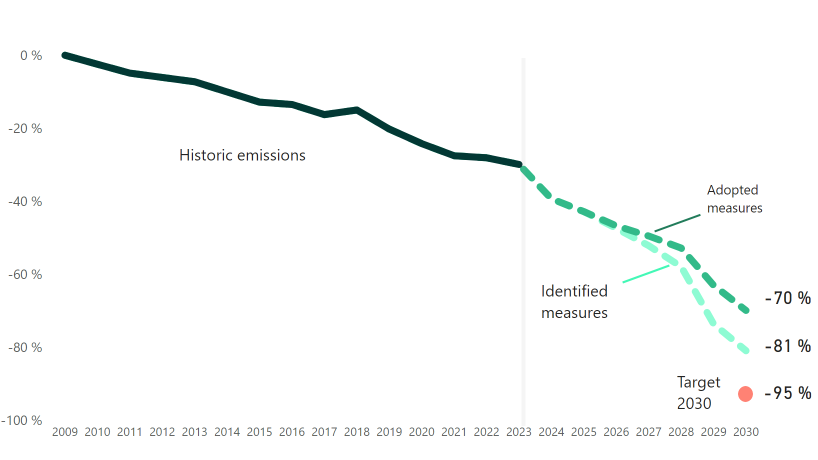
The Climate Budget 2026 shows that emissions can be reduced by 70% by 2030, compared with 2009 levels, with the adopted measures. Figure: The Climate Agency
Allocation of responsibility and reporting
The Climate Budget shows who within the municipality is responsible for implementing each measure and what specific actions are to be taken. Clear allocation of responsibility is essential to achieving real change.
When a municipal agency is responsible for a measure in the Climate Budget, it is also required to report on status and progress. This makes the climate effort more binding and accountable. Reporting takes place in parallel with financial reporting.
Who develops the Climate Budget?
Oslo’s Climate Budget is formally owned by the Department of Finance (FIN), which is also responsible for the municipality’s fiscal budget. This ensures coherence between climate policy and overall economic governance.
The Department of Environment and Transport (MOS) is responsible for the content provided to the annual budget conferences, as well as for preparing the final proposal for the annual Climate Budget. MOS is also responsible for ensuring coordination and anchoring across other City Government departments.
MOS has overall responsibility for the final completion of the Climate Budget, which is carried out in close cooperation with the Climate Agency.
The Climate Agency is responsible for developing the technical and analytical foundation of the Climate Budget and for coordination across the municipality’s agencies.
This includes preparing the Climate Budget’s technical basis and acting as a driving force for climate action within the municipality.
The Climate Agency is also responsible for methodology and calculations, as well as for drafting the Climate Budget itself and the associated technical appendix.
The Climate Budget is part of the municipal budget
Climate action is integrated into Oslo municipality’s ordinary budget process through the Climate Budget. The Climate Budget follows the same timeline as the financial budget, ensuring that climate considerations are assessed on an equal footing with other priorities when the municipality plans and allocates resources.
The municipal budget sets out how the Municipal Master Plan is to be implemented in practice. All municipal agencies participate in the budget process, which runs throughout the year. Over the course of the year, agencies are required to implement the measures set out in the budget and in the allocation letters they receive. Climate action is embedded in the letter with budget instructions issued to agencies by the Department of Finance.
The Climate Budget sets out concrete actions to follow up Oslo’s climate strategy towards 2030. You can read more about how climate action is followed up throughout the year in the annual cycle of the Climate Budgeting process.
The City Government submits the Budget Proposition — including the Climate Budget — to the City Council. The budget process is completed when the City Council adopts the Budget Resolution.
The Climate Budget in a TED Talk
Learn more about how Oslo uses the Climate Budget as a governance tool, explained by Heidi Sørensen, Director of the Climate Agency in Oslo municipality, in a TED Talk.
A living tool in continuous development
The structure of the Climate Budget makes it a living and flexible tool through the city of Oslo’s climate initiatives. It ensures that adopted measures are followed up systematically and makes the municipality’s climate goals more concrete. Each year, the Climate Budget is adjusted in light of new knowledge, changing frameworks and experience from previous years, enabling the municipality to assess what additional measures are needed to achieve the 2030 climate goals. The Climate Budget is therefore in continuous development.
Climate action is an integral part of the governance, budgeting and responsibility of all municipal agencies — and this is followed up every single year.
Guide to the Climate Budget as a governance tool
Would you like to develop a Climate Budget? Oslo, Hamar and Trondheim municipalities have produced a guide to Climate Budgets for municipalities and county authorities. The guide is designed to be used by — regardless of size, resources, or how far they have progressed in their work on Climate Budgets.
You can find the guide here.
C40 is supporting climate budgeting globally
C40 is a global network of mayors from nearly 100 cities driving the future of city climate action. Since 2021, Oslo and C40 have supported a diverse group of early movers in adapting climate budgeting for their own contexts. By 2030 all C40 cities will introduce climate budgeting as a membership requirement. The C40 Knowledge Hub contains resources and updated status of cities. To support cities, the C40 Climate Budgeting Programme published a Climate Budgeting Framework establishing the principles and criteria of a robust climate budgeting system, along with a Step-by-step guide to climate budgeting, offering practical how-to guidance. Public servants can also access climate budgeting online courses for government leaders and practitioners.