
Size: large
Type: image
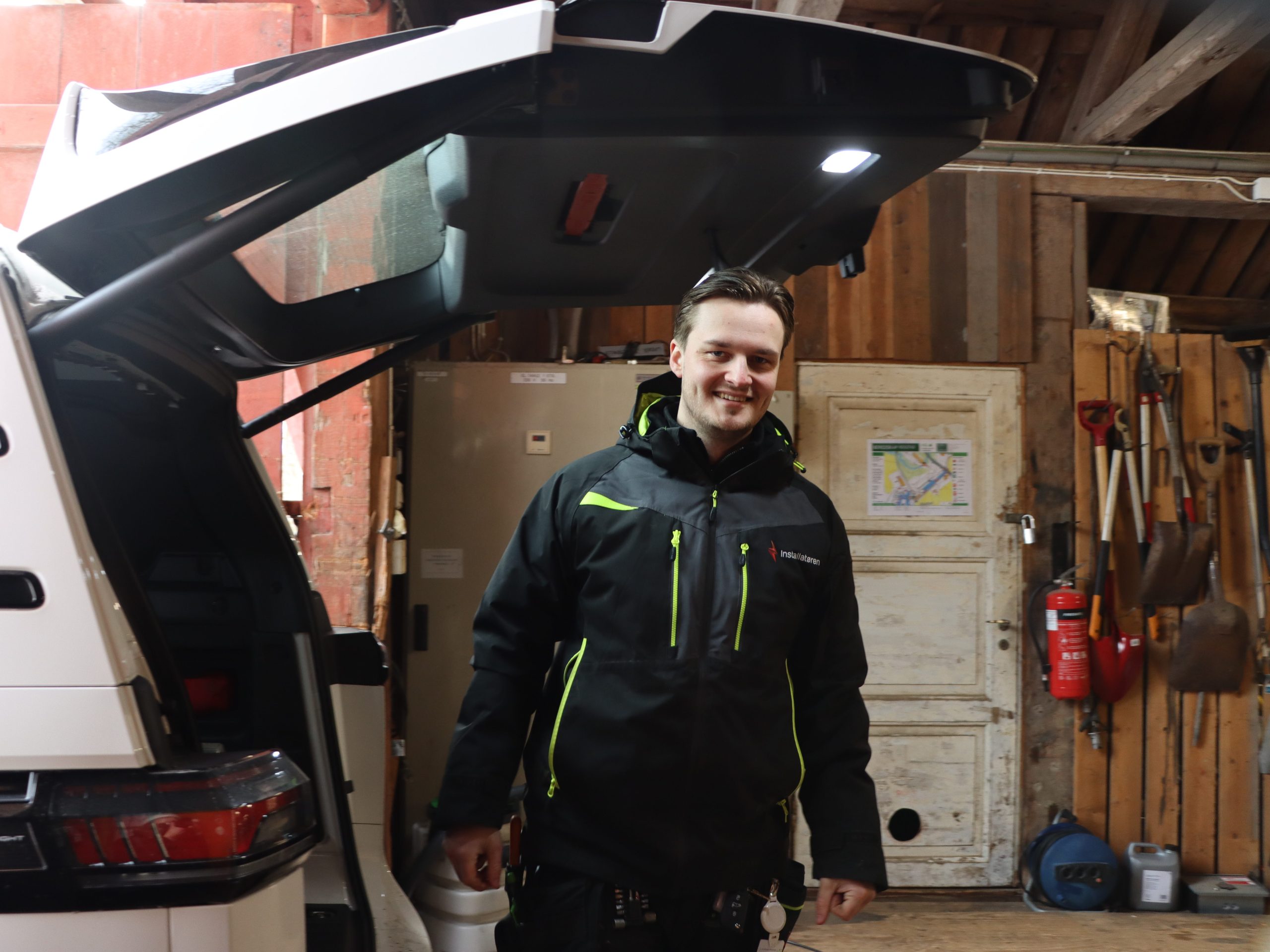
Installatøren AS is one of several contractors with framework agreements with the City of Oslo. Today, electrician Tobias Bondevik is replacing halogen lights with energy-efficient LEDs in a barn at Bogstad Farm.
“I was worried about charging often when I got an electric van, but it’s gone very smoothly,” says Bondevik.
The company drives an electric ID. Buzz and says the transition to zero-emission vehicles has exceeded expectations.

"All the lamps in the barn are being replaced, from halogen to energy-efficient LED lights," says electrician Tobias Bondevik from Installatøren AS, as he loads the old fixtures into the electric van.
“We see the new requirements from the City of Oslo as positive since environmental focus is an important part of our business,” says Daniel Strand, Department Manager at Installatøren AS.
He emphasizes close cooperation with the municipality:
“We find that both sides are committed to finding optimal solutions while supporting the green transition.”

Daniel Strand, Department Manager at Installatøren AS (left), Tobias Bondevik, Electrician, and Marius Normann Skjærstad, Service Manager at Installatøren.
Everyone Must Drive Zero-Emission
All suppliers working for the City of Oslo must now use vehicles running on electricity, hydrogen, or biogas — whether transporting goods, services, or people. This applies to passenger cars, vans, trucks, and buses.
Special standards apply to mass transport and construction-site logistics.
With Oslo aiming to cut emissions by 95 percent by 2030, reducing emissions from vans and heavy transport is crucial, as these sectors lag far behind passenger cars.
“We introduced standard climate and environmental requirements for transport as early as 2019,” says Gunnar Wedde, Director of Procurement Services in the City’s Agency for Development and Competence.
“Back then, suppliers were rewarded for offering zero-emission vehicles. Now it’s mandatory for all contracts over NOK 100,000.”

Gunnar Wedde at the Agency for Development and Competence in the City of Oslo is responsible for overseeing procurements.
Time to Transition
Since the first requirements were introduced, the municipality has seen a positive market shift — more suppliers are now investing in zero-emission vans and trucks.
“The transition has happened faster than expected, which is great to see,” says Wedde.
The city announced already in 2019 that all contracts involving transport would require biogas or zero-emission vehicles.
“The industry has had plenty of time to adapt, and those who switched early have benefited,” says Wedde.
As one of Norway’s largest public purchasers, Oslo uses its procurement power to influence the market.
A 2024 survey by the Climate Agency and the Norwegian Electric Vehicle Association showed that client requirements were among the main reasons companies adopted electric vans.
-
- Oslo’s Climate Strategy, adopted by a broad majority in the City Council, sets the goal of becoming a zero-emission city by 2030.
- From 2025, the City of Oslo requires zero-emission or biogas vehicles in all contracts where transport is part of the service.
- Public procurement is a key strategic tool for achieving this goal: over 50 percent of Oslo’s greenhouse gas emissions come from sectors that rely on transport.

Home-charging
«To solve the challenge of charging, we’ve made sure that all employees who have the option of home-charging get their own charger installed. In addition, we cover the charging costs so that they always have a fully charged vehicle when they arrive at work. This ensures a smooth and efficient workday, while also supporting our focus on sustainability,» says Daniel Strand.
Not everyone, however, has the option to install a charger at home. In those cases, charging costs are covered either at a municipal charging point or at one of the 11 chargers the company has installed outside its office.
«I charge at a municipal station near my home,» says Tobias Bondevik at Installatøren AS.
Strand adds that although charging at home is usually sufficient for the electricians, customers are positive when there’s an occasional need to charge at the job site.
Installatøren AS has had a framework agreement with the City of Oslo for eight years and has just renewed the contract for another four. Daniel Strand believes it’s a good thing that the municipality uses its procurement power in this way.
«The green transition is a shared responsibility that doesn’t rest only on large actors like the state and municipalities. Smaller private companies also play an important role in this transformation.»
The municipality’s requirements for construction and civil engineering projects have also been revised. The new requirements for such projects can be found here. These differ from the transport requirements in certain areas.
This story was originally published in Norwegian in March, 2025