
Size: large
Type: image
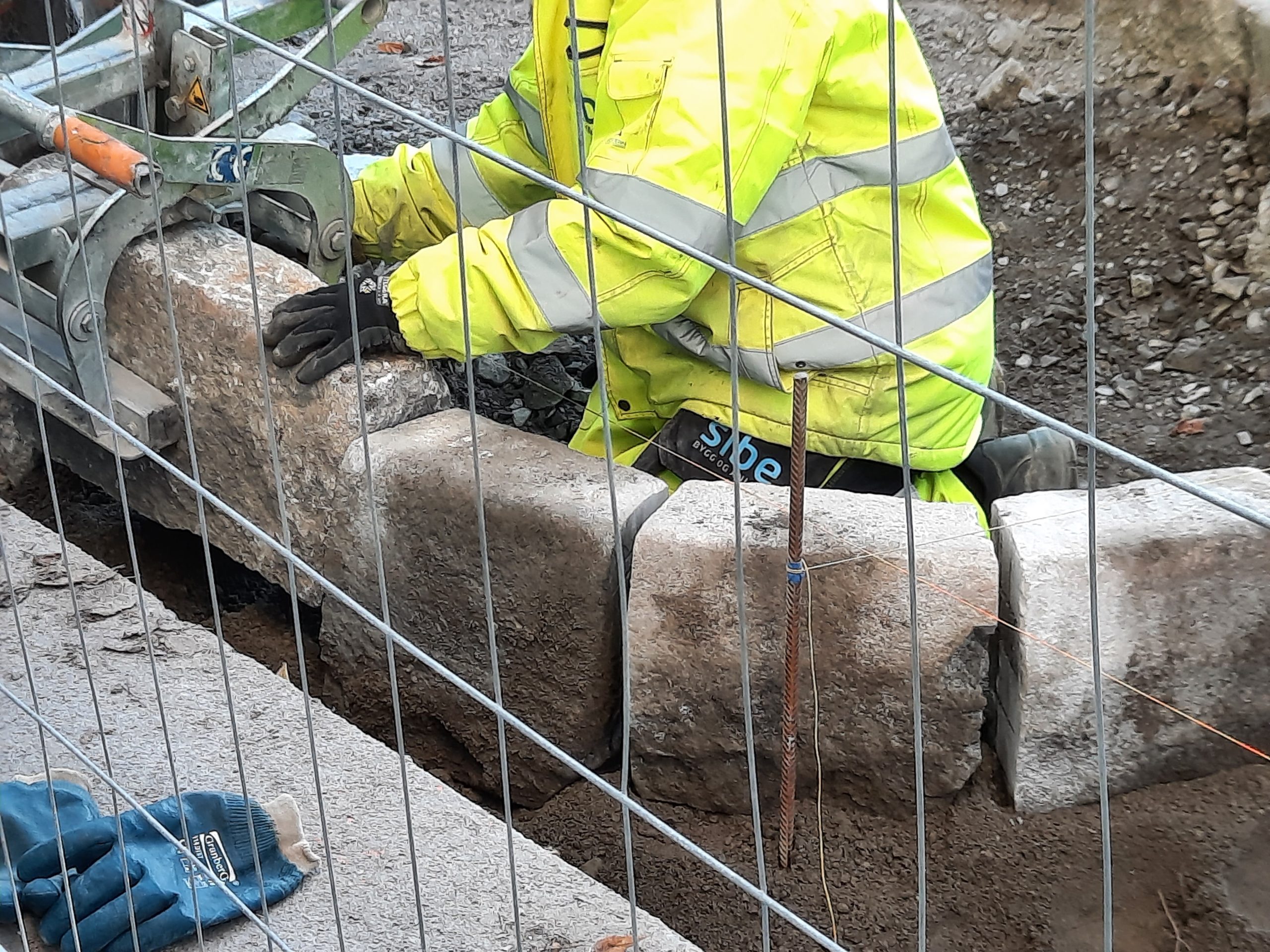
There’s a bit of snow, but the stones are still clearly visible at the City of Oslo’s outdoor storage site. In Persveien at Alnabru, stacks of kerbstones, paving slabs and small cobblestones are left over from other street and road projects. Now they can be used in new projects.

In Persveien at Alnabru, the City Environment Agency has a storage site for surplus stone that can be used in new projects.
“We’ve had this storage site for about four years,” says the person in charge, Frank Liland at the City Environment Agency in the City of Oslo.
Taking care of the stone is important, because it is a limited resource – even here in the rock-rich north. Norway is the country in the world that uses the most stone per person, according to SINTEF. A full 12 tonnes each, every year.
“There’s a lot of Grorud stone here. Do you see that red stone there?” Liland says, pointing. “It comes from an old quarry in Grorud. You can’t get more local than that.”

Frank Liland at the City Environment Agency is responsible for the City of Oslo’s stone storage site.
It’s a good mix of older so-called Oslo stone – meaning it has been cut with a slightly rough surface – and “China stone”, which has straighter faces.
For many years, the City of Oslo has focused on reusing stone when roads are maintained. A storage site makes it even easier to systematise this. Here, stone can be stored temporarily and surplus stone can be placed for later use.


Metres and metres of stone
The renovation of Jens Bjelke street in Tøyen is the project where the City Environment Agency has succeeded best in reusing stone. The street was renovated in 2022, and only 190 linear metres of the stone there is new, says project manager Lars Olav Farstad at the City Environment Agency.
“Almost two-thirds of the stone has been reused on site, and one-third of the stone in the street has been collected from the stone depot. It was surplus stone from other projects that would otherwise have been thrown away,” Farstad says.

Lars Olav Farstad is responsible for street and road projects at the City Environment Agency. Photo: Sondre Voldene. Foto: Sondre Voldene
Now, 190 metres of stone might sound like a lot, but when the road being upgraded was over 1 km long, and kerbstones have been laid metre after metre along new trench edges, 190 metres is not much.
Studies show that reusing street stone can lead to major cuts in greenhouse gas emissions. According to SINTEF, reusing stone results in less than 10 percent of the greenhouse gas emissions compared with laying new street stone.
That benefits both the city and those of us who live here.
Flexibility is the key when ambitions for reuse are high, Farstad explains. It can be difficult to plan the entire project in advance when you don’t know what stone will be available.
“When we were in the planning phase for the maintenance of Jens Bjelke street, we imagined laying small stones under the bicycle parking area, but we had to change this because we couldn’t find the right stone in the depot. Instead, there were large, fine paving slabs available, which we decided to use as the surface under the bike stands,” Farstad says.
- Facilitated cycling in mixed traffic in the upper part of the street
- New cycle lanes in the lower part
- Upgrade to wide and a raised cycle lane in Tøyengata
- Cycle passage at Sørli square
- 21 bicycle stands installed
- Eight junctions tightened up to achieve lower speeds and shorter, clearer pedestrian crossings
- Tactile paving for people with visual impairments at all junctions
- 18 new benches installed along streets and in parks
- Old benches in the area refurbished
- Improved lighting in dark sections
- Improved growing conditions for 32 mature trees by replacing asphalt with soil and grass
- Six new trees and many berry bushes planted
- A pétanque court in Sommerfrydhagen
- Several rain gardens with perennials
- Stormwater solution with retention in Snippen
- Kerbstones, cobblestones and paving slabs reused on a large scale
- Puddles removed, the carriageway and pavements resurfaced.

Reused paving slabs under the bicycle parking area in Jens Bjelkes gate.
Requirements for contractors
The City Environment Agency is currently running a pilot project where contractors are required to deliver climate accounts for their services and documentation for this. It counts positively when contracts are awarded if they can demonstrate reduced emissions.
“If contractors write in their tender that the stone can be reused, it’s easier to win the job than if new stone is purchased – and thus quarried and transported over long distances,” Farstad says.
The aim is to cut emissions both from transport and from impacts on nature. Reused stone also saves money for both the contractor and the municipality. Aesthetics also matter in a street project. Old stone can look better in a streetscape with older buildings.
“We see that in an older street it looks nicer if the stone matches the surrounding buildings. Our gut feeling, for those of us who work with this, is that this is the right direction to go.”
For now, only the City Environment Agency’s own projects can collect stone from the depot.


Circular at every stage
“We have to think circularly at every stage,” says climate adviser Veronica Sund at the Climate Agency in the City of Oslo, on the need to reuse street stone.
Emissions from construction and civil engineering accounted for 16 percent of greenhouse gas emissions in Norway. By considering emissions at every stage, the City of Oslo moves closer to its target of a 95 percent reduction in greenhouse gas emissions by 2030.
“The City of Oslo’s stone depot shows that we can reuse more and more of the important resources in society, as long as we are good at planning and logistics. The City Environment Agency shows that this is achievable,” Sund says.
Now the norm is that cobblestones and paving slabs should be reused, not thrown away.
Those with a trained eye may notice that new stones have a lighter colour when a street project has just been completed, but a winter or two quickly makes the stone look the same.
This story was originally published i Norwegian, February 2025